
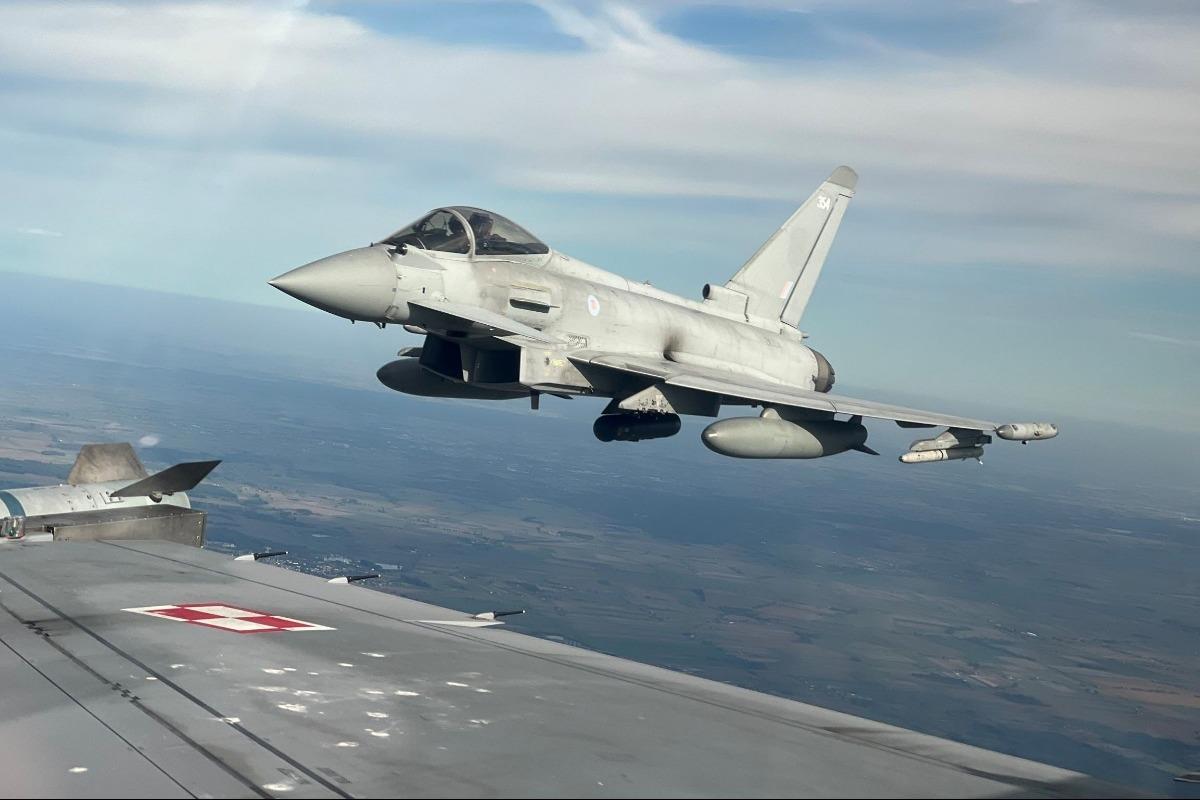
In 2025, NATO launched a wide-ranging security initiative called "Eastern Sentry", which aims to strengthen the defence of the Alliance's eastern flank and respond to growing threats in the region. This operation was announced on September 12, 2025 in response to incidents of airspace violations of allied countries, including a serious case of Russian drones entering Polish territory in September this year.
Eastern Sentry is working to strengthen the air defence of member states, the integration of reconnaissance systems and military response across the region[1]. One of the most important components of this initiative is the AIRCOM-led F2T2 (Find, Fix, Track and Target) exercises, which in practice serve both training and real operational support for the Alliance.
The F2T2 exercises took place on 4 December 2025 and were carried out over Poland and in the area of the eastern flank in direct support of the "Eastern Sentry" operation. The air forces of six NATO countries took part in the maneuvers: Germany, the Netherlands, Polish, Spain, the United Kingdom and the United States. The cooperation between these countries has allowed for the implementation of complex activities of detecting and guiding allied forces, which has strengthened the common situational picture of the region.
The F2T2 exercises organized by the Allied Air Command (AIRCOM) are a response to today's security challenges, which require rapid detection, accurate positioning, tracking and precise guidance of strike forces. This programme brings together multinational aeronautical and ground elements and support systems, enabling coordination between different NATO member states
In practice, the F2T2 exercises over Poland and the Baltic region included activities involving advanced observation and combat systems, integrating data from airborne and ground-based sensors, which improved the Alliance's common situational picture and response capability. Thanks to the use of modern command and communication systems, participants were able to improve multi-domain cooperation procedures.
At the heart of this multi-domain training is a commitment to improving Allied operations. The F2T2 are made up of wholly volunteer Allied nations that donate national resources to cooperate, plan, and analyze. This requires a holistic understanding of the training environment from operators on the ground supporting Command and Control (C2); by distributed planners and intelligence, surveillance and reconnaissance (ISR) specialists; airborne crews, and ultimately to senior commanders making decisions. F2T2's multi-domain integration provides opportunities to further improve the readiness and tactical prowess of Allied forces.
F2T2 test the ability of allies to perform distributed operations while advancing human interoperability. By learning from each other, F2T2 participants build trust by identifying best practices and lessons that can be carried over to the next edition of F2T2[2].
Such actions take place in the context of NATO's broader commitments to strengthen the eastern flank, as part of the "Eastern Sentry" program. This initiative not only strengthens the presence of allied troops, but also aims to clearly demonstrate NATO's solidarity with its members and its ability to respond flexibly to new security challenges[3].
Involvement in the F2T2 exercise is an important step in achieving these goals, allowing for the practical improvement of interoperability and multinational cooperation, which is the foundation of the Alliance's deterrence and defence capabilities. By strengthening the operational readiness of NATO countries and facilitating the rapid exchange of information between air and ground components, these exercises help to create a more integrated defence system capable of countering new threats in a real European security environment.
[1] https://www.gov.pl/web/obrona-narodowa/nato-uruchamia-eastern-sentry-aby-jeszcze-bardziej-wzmocnic-wschodnia-flanke - NATO uruchamia Eastern Sentry, aby jeszcze bardziej wzmocnić wschodnią flankę, gov.pl
[2] https://ac.nato.int/archive/2025-2/aircomled-f2t2 - AIRCOM-led F2T2 training supporting NATO’s Eastern Sentry- NATO
[3] https://www.nato.int/en/news-and-events/articles/news/2025/09/12/nato-launches-eastern-sentry-to-bolster-posture-along-eastern-flank - https://www.nato.int/en/news-and-events/articles/news/2025/09/12/nato-launches-eastern-sentry-to-bolster-posture-along-eastern-flank - NATO launches “Eastern Sentry” to bolster posture along eastern flank, NATO
Photo: RAF
This article was prepared as part of the public task commissioned under the Government Programme for the Development of Civic Organizations 2018–2030: “Safe Poland of Tomorrow – strengthening the mission-driven activities of the Alioth Foundation.”
