
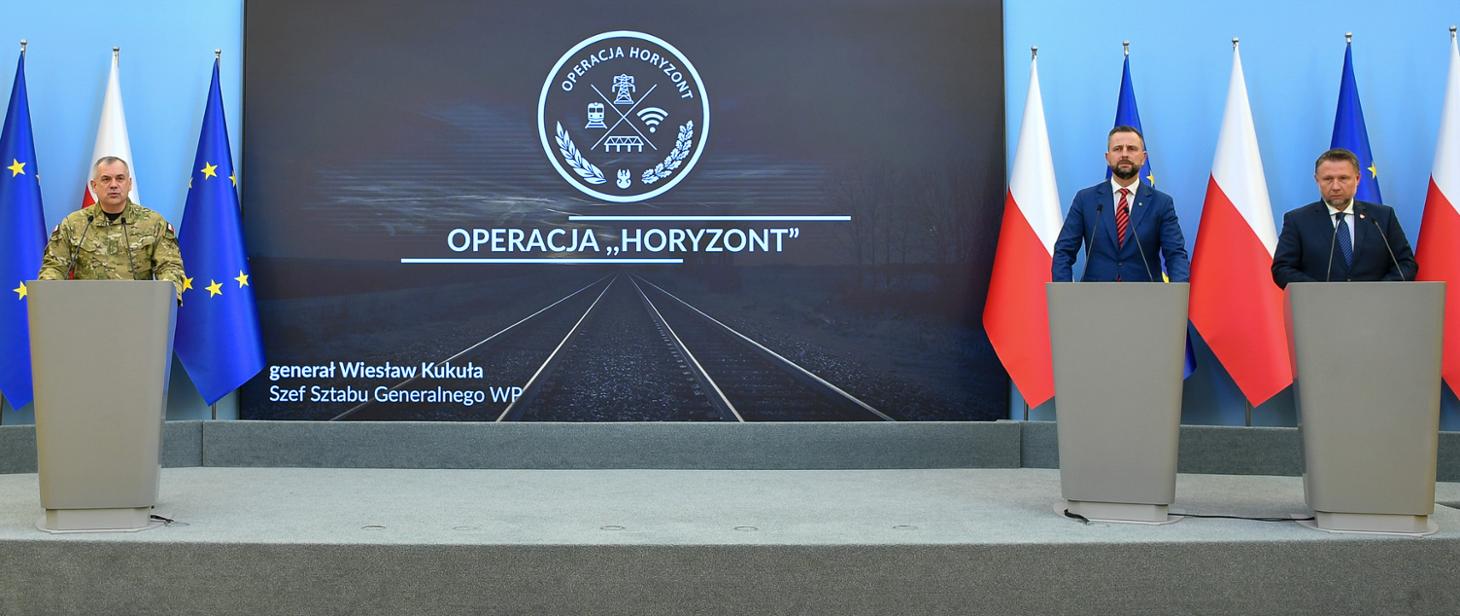
The Polish government, the Ministry of Digital Affairs and the Cyberspace Defence Forces are launching a new mobile application as part of Operation Horizon, allowing citizens to report potential threats, acts of sabotage or suspicious activities. The initiative aims to strengthen cooperation between civilians and the military in protecting critical infrastructure and responding more effectively to emerging security challenges.
The application is being developed by the Cyberspace Defense Forces. According to the announcement, it will allow users to describe incidents, upload photos and share accurate location data, helping security services respond faster and more accurately. Deputy Minister for Digitization Michał Gramatyka emphasized that the geolocation of the photos will help the services accurately determine the location of the incident, which will increase the effectiveness of interventions. The test version of the application is to be launched at the turn of November and December, and the full public version is to be launched around mid-December.
General Wiesław Kukuła, Chief of the General Staff of the Polish Armed Forces, emphasizes that the application solves the problem of accurately determining the place of the incident, which is one of the key difficulties in reporting incidents. For the authorities, this also serves as a tool for social mobilization: by identifying worrying situations, citizens are available in the emergency system.
The application is being developed in the context of Operation Horizon, which involves deploying up to 10,000 soldiers to support state services in protecting key infrastructure across the country. The operation is a response to growing hybrid threats and hostile actions aimed at disrupting public safety and operational readiness, such as the recent sabotage activities in the Lublin Voivodeship.
Application Functioning
Many people wonder why these options cannot be included in the mObywatel application? The decision on whether the threat reporting function should be added to mObywatel has its pros and cons. The advantage would be that the app already has a huge user base, works stably on Android and iOS, and has a team that could quickly implement the new feature, which would reduce costs. On the other hand, there are serious drawbacks: the military would not have full control over the data, because it belongs to the Ministry of Digital Affairs, and some citizens do not trust the government application and perhaps would more easily trust a solution created directly by the military. Added to this is the risk of centralizing systems, as the recent failures of large cloud services have shown.
In Poland, there are already several applications that allow you to report threats, both national and local, so the decision did not apply only to mObywatel. The military was faced with a choice: to join the existing platform or create its own. In the end, the choice was to build a new solution, probably for reasons related to user control and trust, and the difference in costs would not be significant. The military also has great competence in creating secure software, an example of which is the Merkury 2.0 messenger, so it can be assumed that the new application will be well secured. It is also possible that in the future, applications such as mObywatel will be able to forward reports to one system via the API provided.
However, it is not yet known how the problem of user verification and avoiding fraudulent reports will be solved. It was not specified whether logging in would be required, and if so, how it would be done. Time will tell, because there is no official information on this subject yet.
State officials emphasize that the application will not only be a technological solution. It will also be a tool to increase public awareness and public engagement. According to the military command, many reports from citizens do not contain precise information about the location of incidents, which complicates response activities. The new app is supposed to solve this problem by automatically providing accurate coordinates and photos.
At the same time, the draft raises doubts and potential concerns. Critics point to the possibility of false reports, system overload, and privacy and data protection issues, especially since the app will handle sensitive user data such as photos and geolocation. How these challenges are addressed can determine the long-term success and social acceptance of the system.
Despite these concerns, the app represents an important step in the modernization of the Polish national security system.
Photo: MON
This article was prepared as part of the public task commissioned under the Government Programme for the Development of Civic Organizations 2018–2030: “Safe Poland of Tomorrow – strengthening the mission-driven activities of the Alioth Foundation.”
